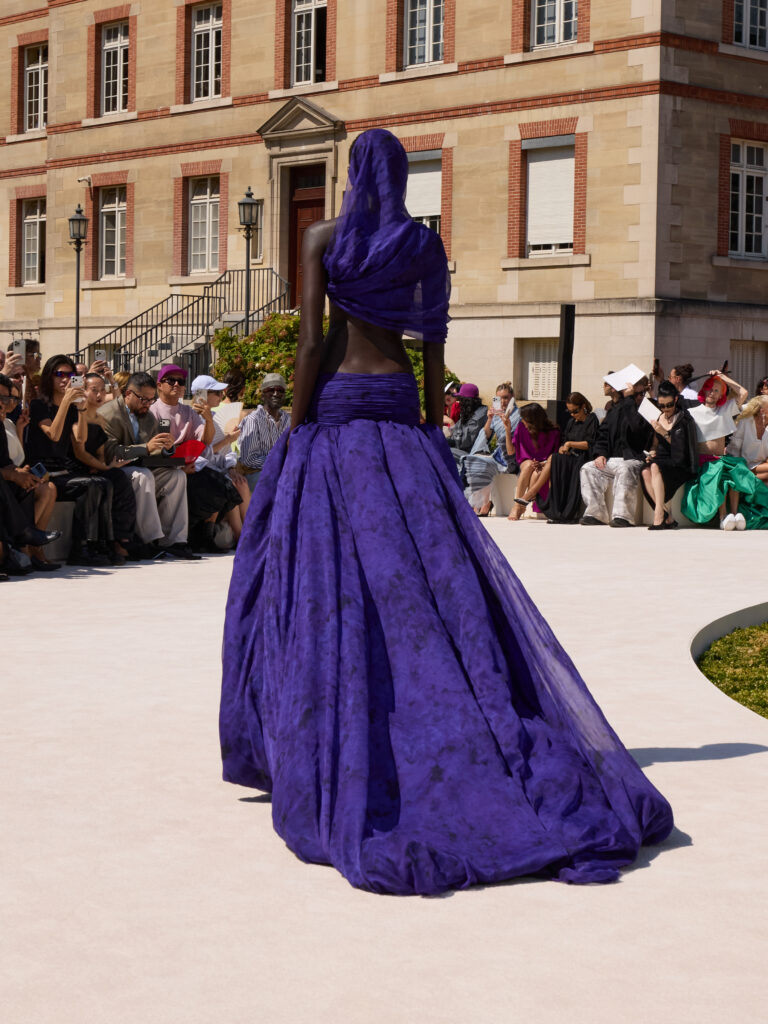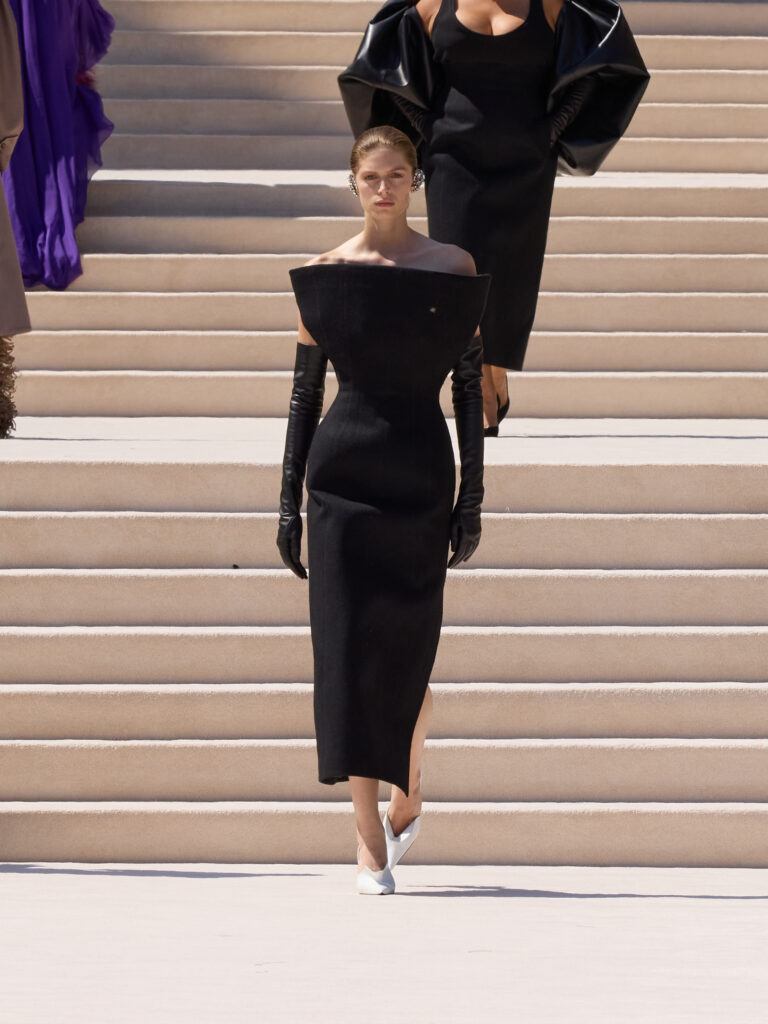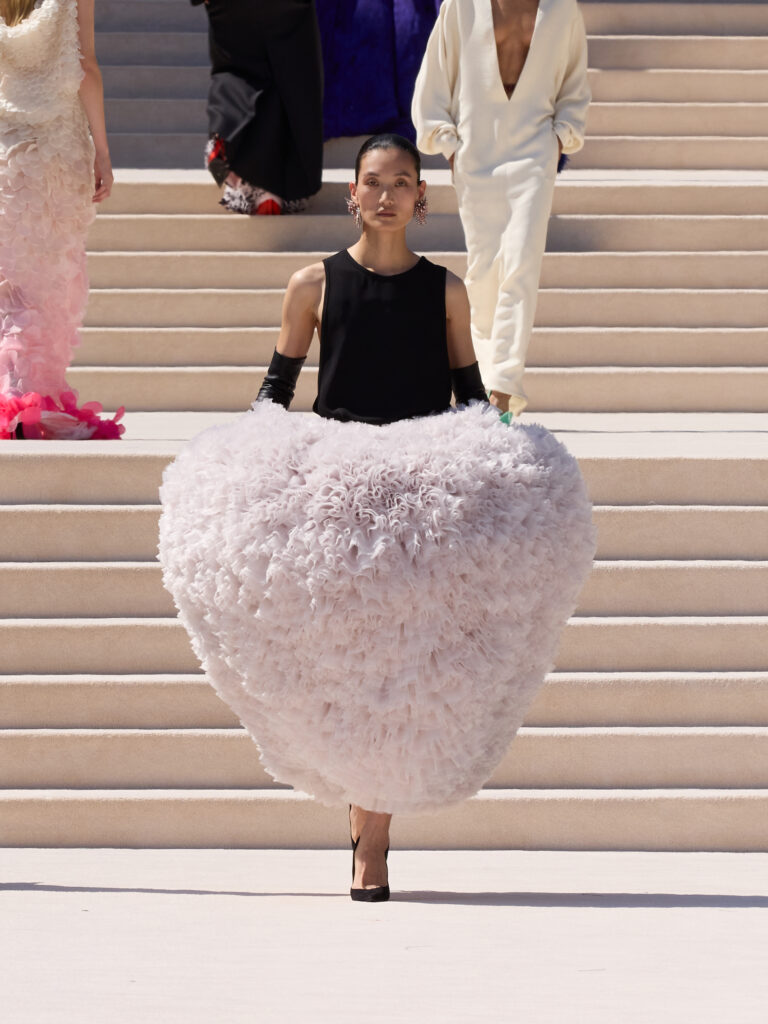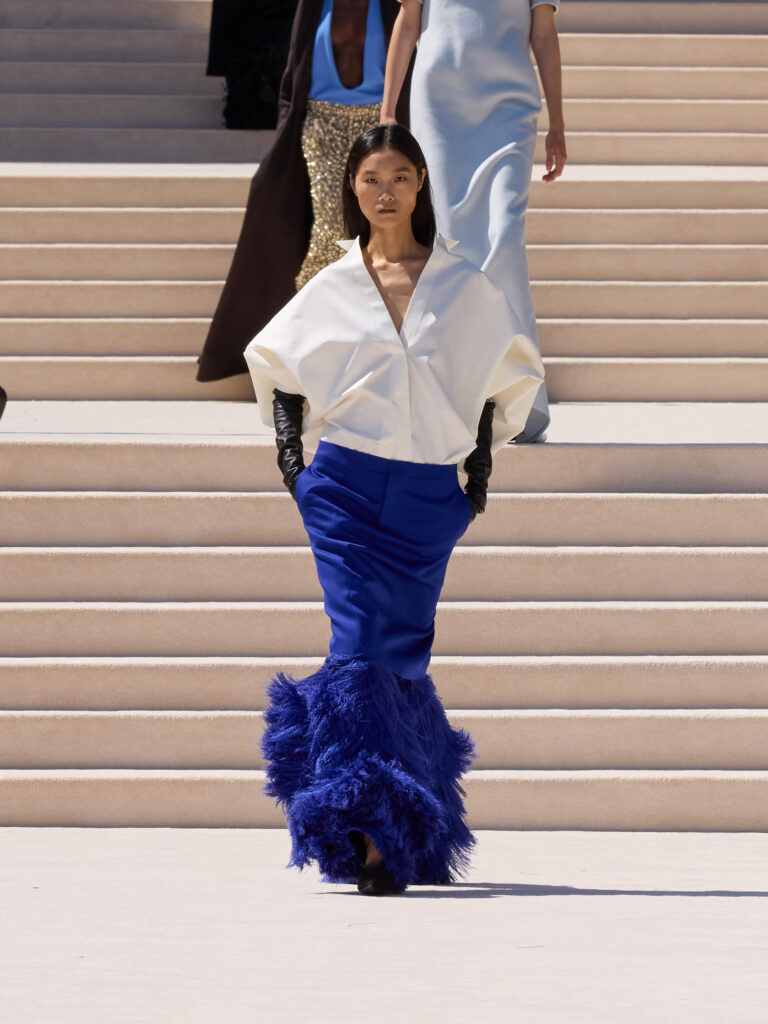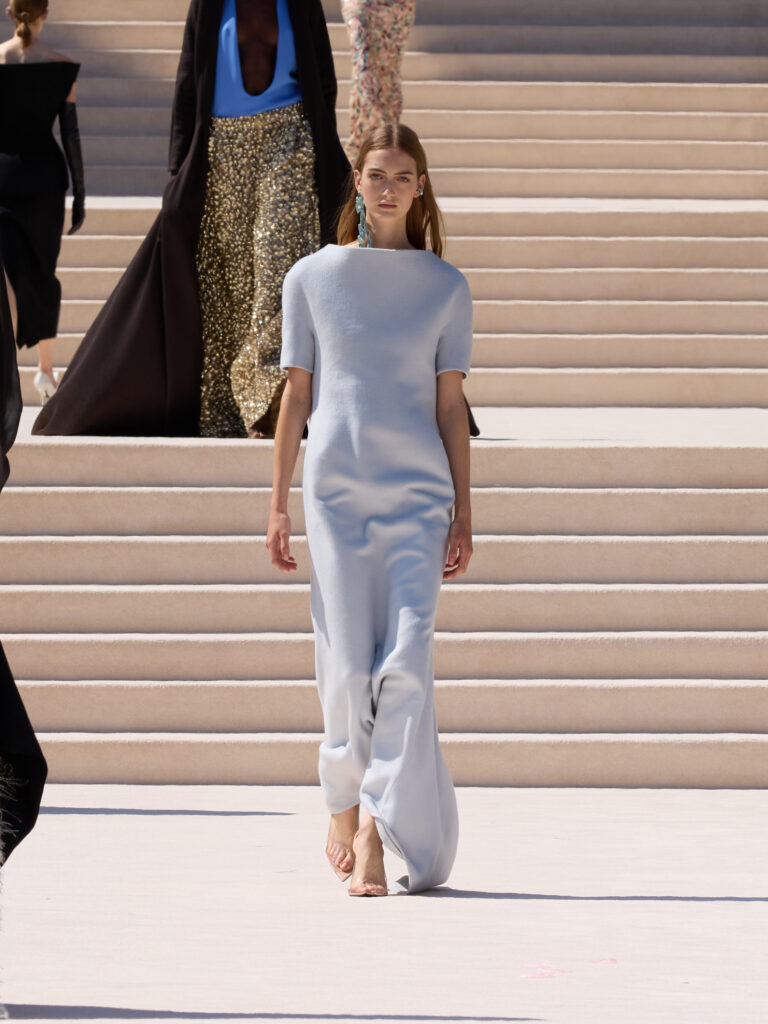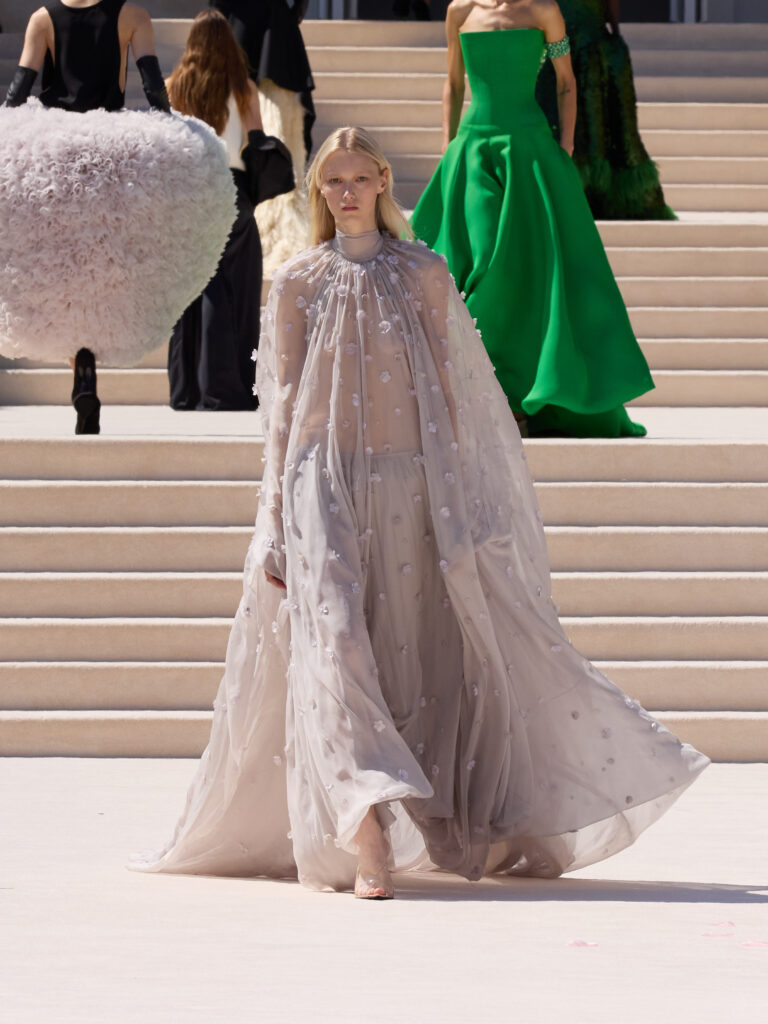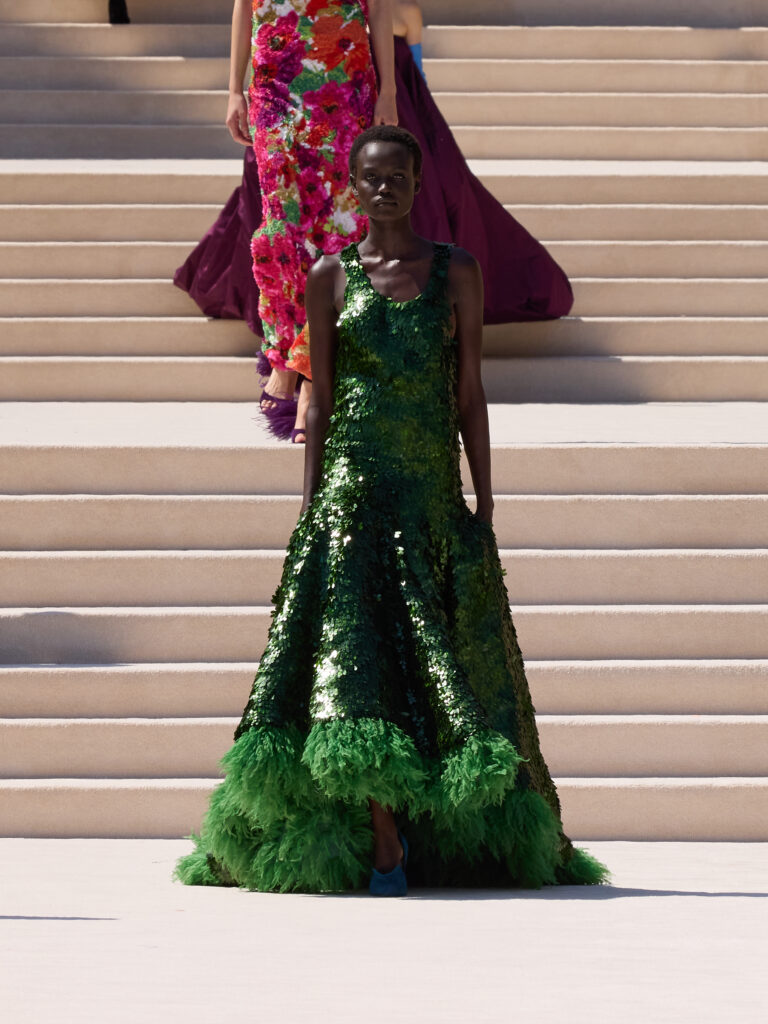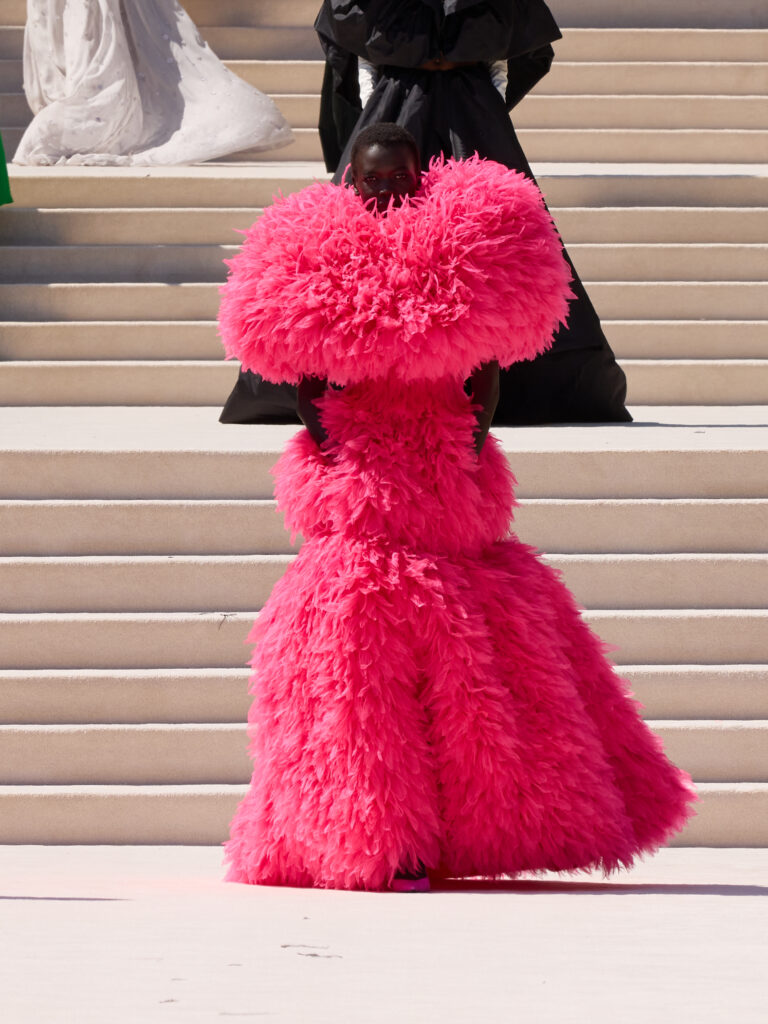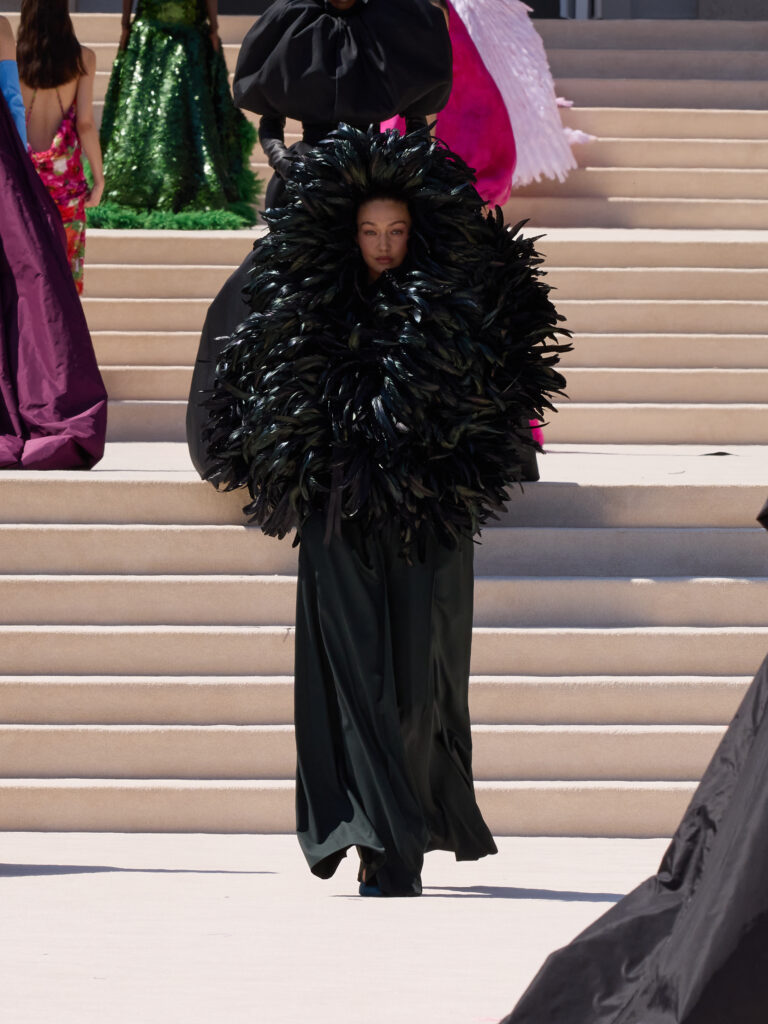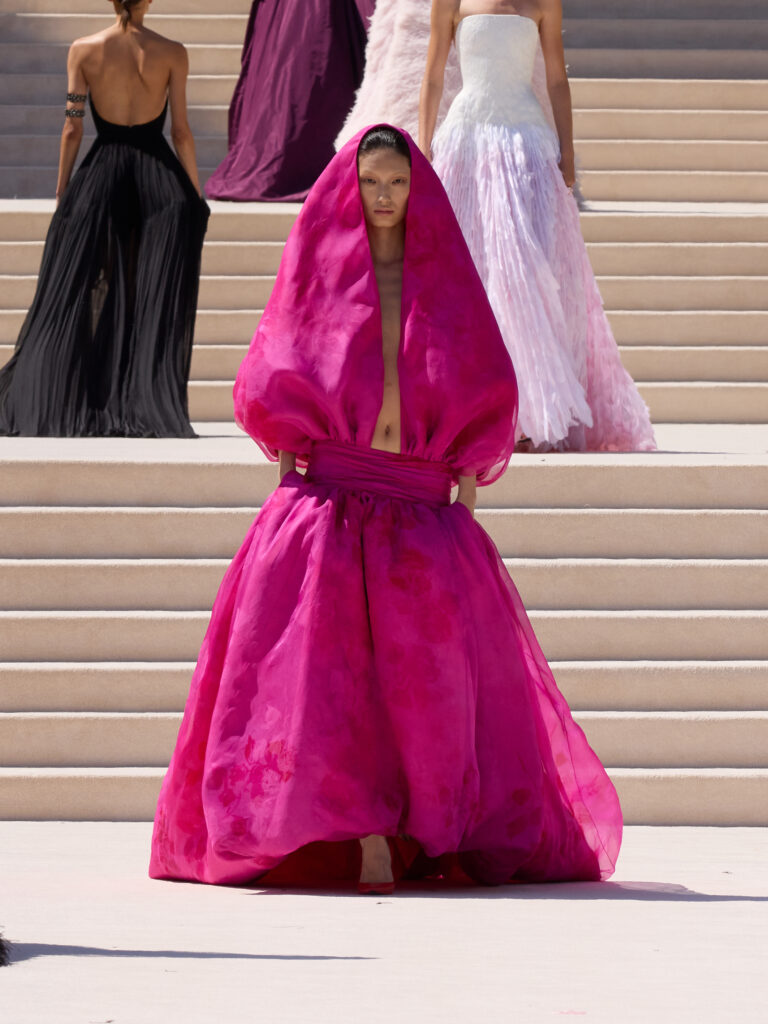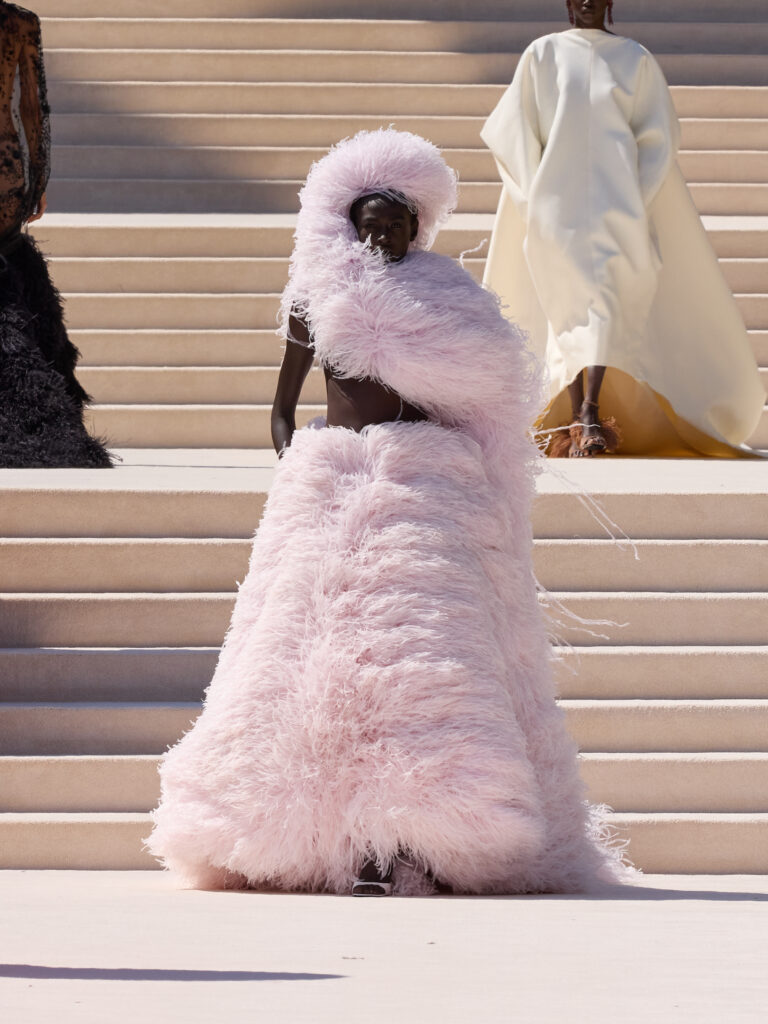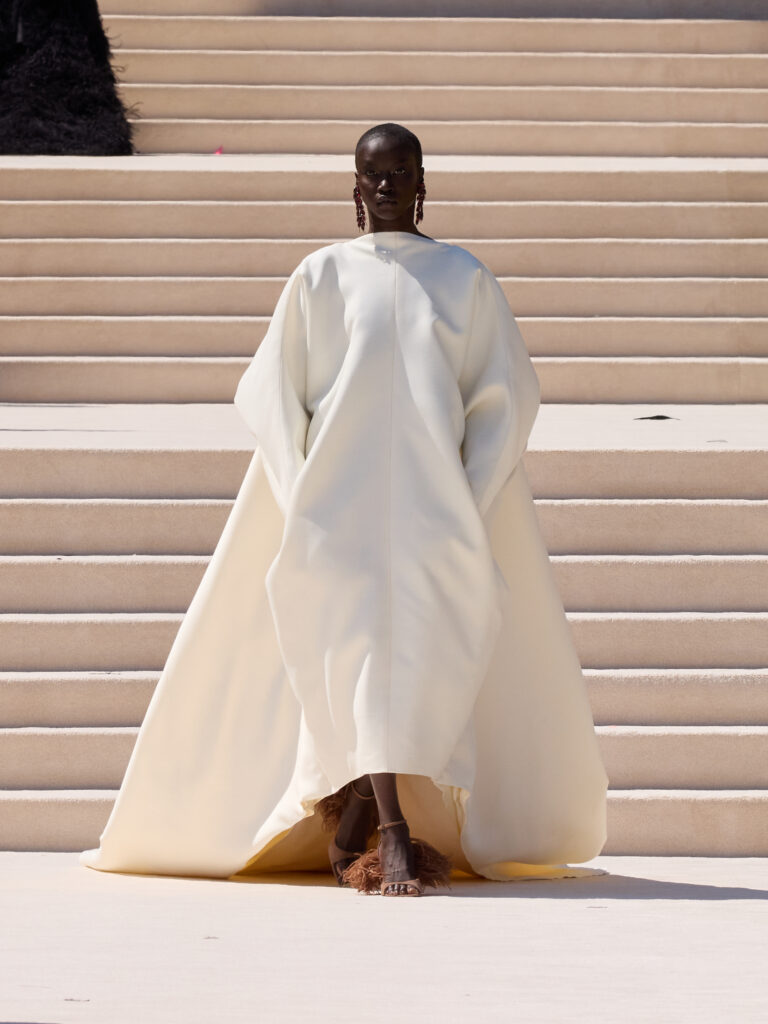
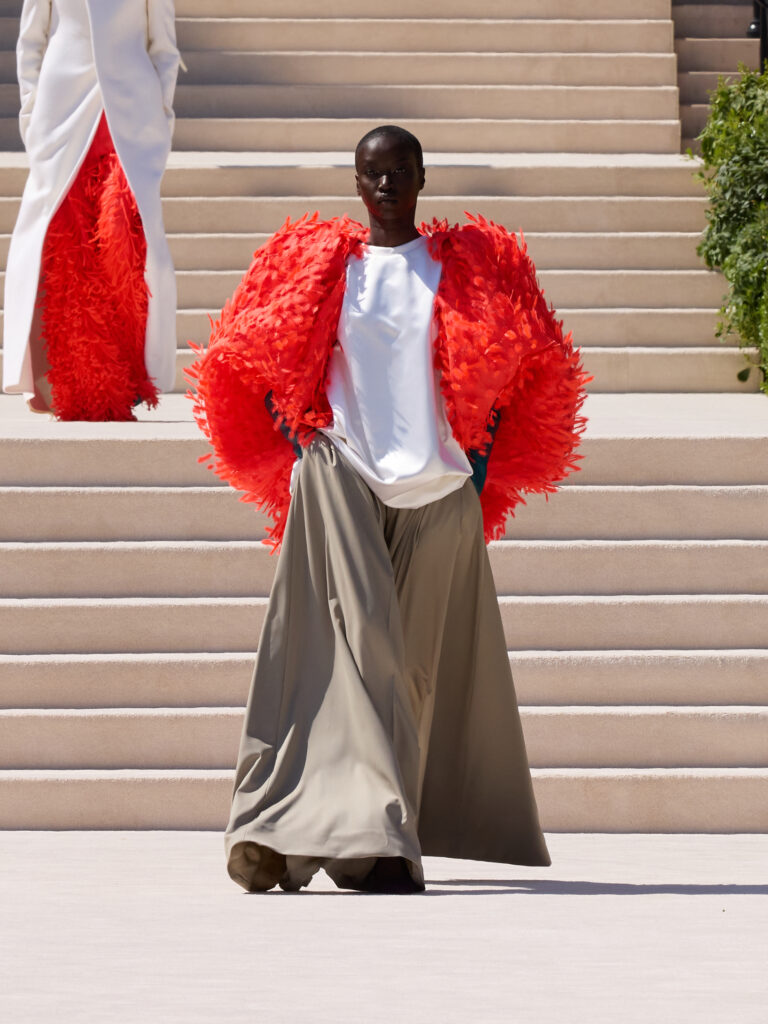
The hush that falls over a couture audience when it senses it is not watching a collection so much as a reckoning. This happened on the morning of July 8, in the circular garden of the Cité Internationale Universitaire de Paris, a location itself worth pausing on, since Piccioli chose to leave behind the gilded, mirrored salons of 10 Avenue George V for open sky and manicured lawn. No spectacle of architecture to hide behind. Just cloth, body, and the merciless honesty of daylight. The temperature that morning climbed past 30 degrees; editors fanned themselves with the show notes while waiting for the first look. It arrived not in black, the color that has, for seventy years, functioned as Balenciaga’s signature and its shield, but in a white silk T-shirt and loose beige wool trousers. A soft act of defiance disguised as simplicity. This was Piccioli telling the room, before a single embellishment appeared: I am not here to imitate. I am here to understand.
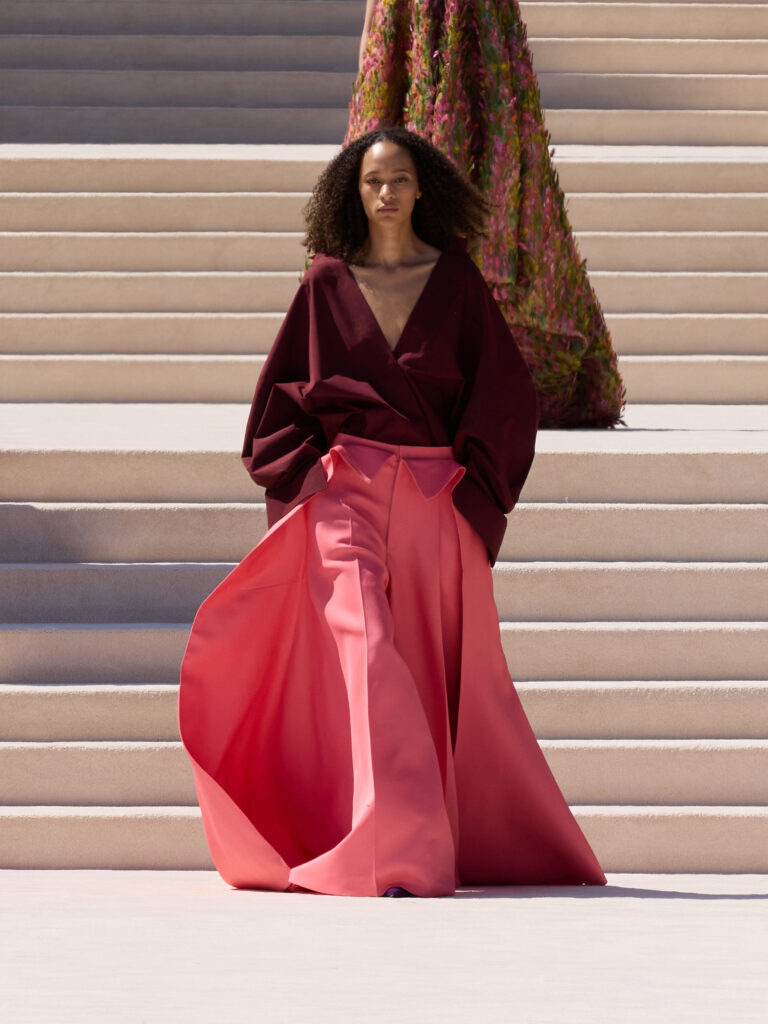
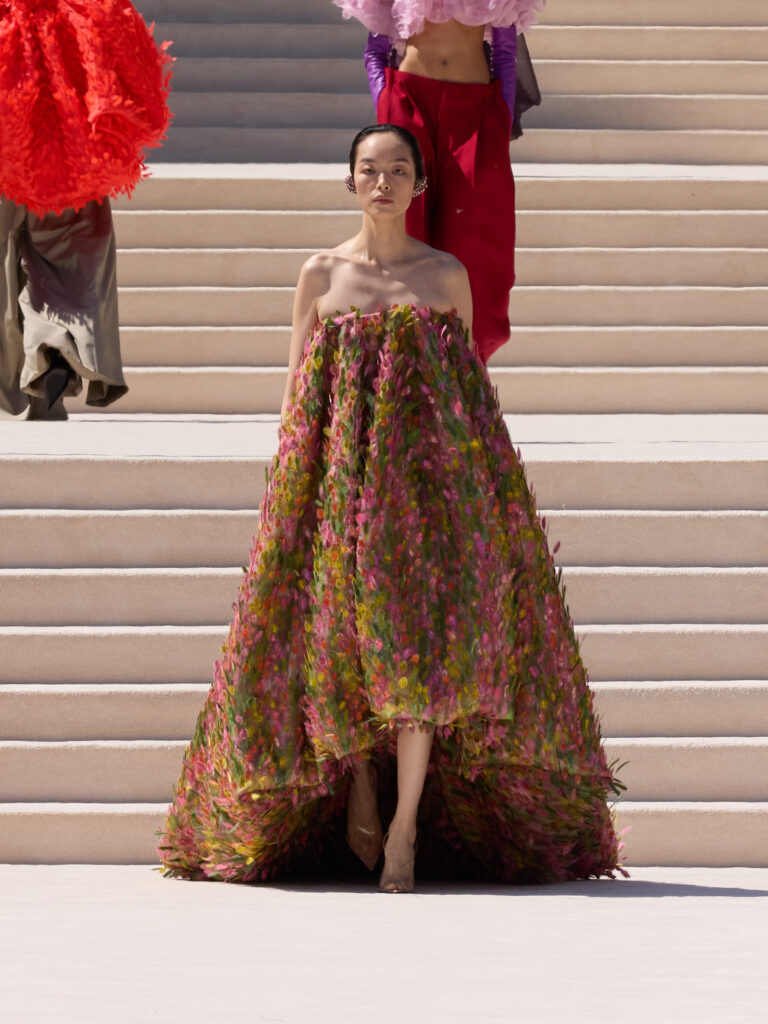
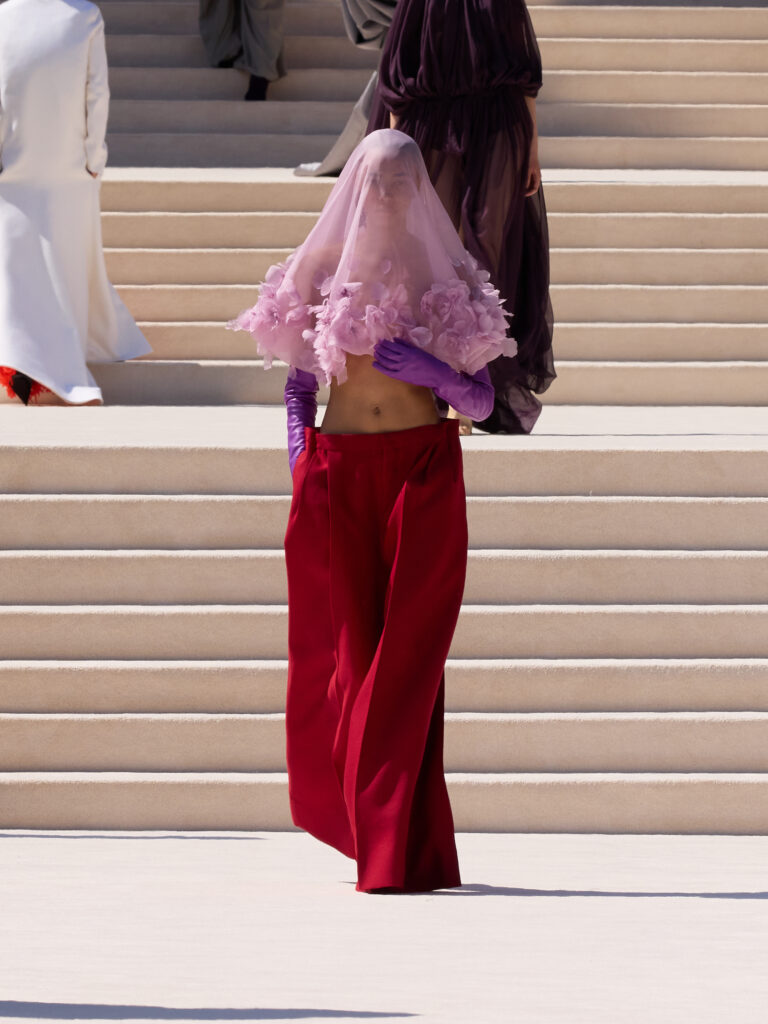
That distinction, between imitation and understanding, is the entire thesis of the 55th Balenciaga Couture Collection, the first conceived in full by Pierpaolo Piccioli since his appointment was confirmed in May of last year, following a seventeen-year tenure remaking the emotional register of Valentino. The pairing, on paper, looked like a collision: Piccioli’s known instinct for romanticism and color meeting Cristóbal Balenciaga’s austere, architectural rigor. What he gifted us instead was neither collision nor compromise, but something closer to translation,fifty-two looks that treat couture not as a costume of the past but as, in his words, “information”: a coded language of construction, proportion and material that can still speak in the present tense.
It took me weeks to write this article because a collection this dense with intention rewards exactly that.
Change, from the Inside Out
The house’s own text is unambiguous, almost combative, in its refusal of nostalgia: change comes from inside. It is a sentence that could be dismissed as designer-speak if it weren’t so precisely borne out in the construction of the clothes themselves. A sequence of tailored coats and dresses in cashmere began not on a mannequin but on a body, individuals three-dimensionally scanned, their stances and attitudes translated into internal leather carapaces, structures worn beneath the garment rather than imposed upon it from without. The effect, seen on the lawn that morning, was a paradox that only couture at this level can resolve: pieces that appeared architecturally rigid from a distance and, up close, moved with the ease of something worn and not simply built. This is Piccioli’s real inheritance from Cristóbal Balenciaga, not the silhouettes themselves but the founder’s obsession with the relationship between fabric and the body it houses, the conviction that a coat’s authority should come from its cut, never its weight.
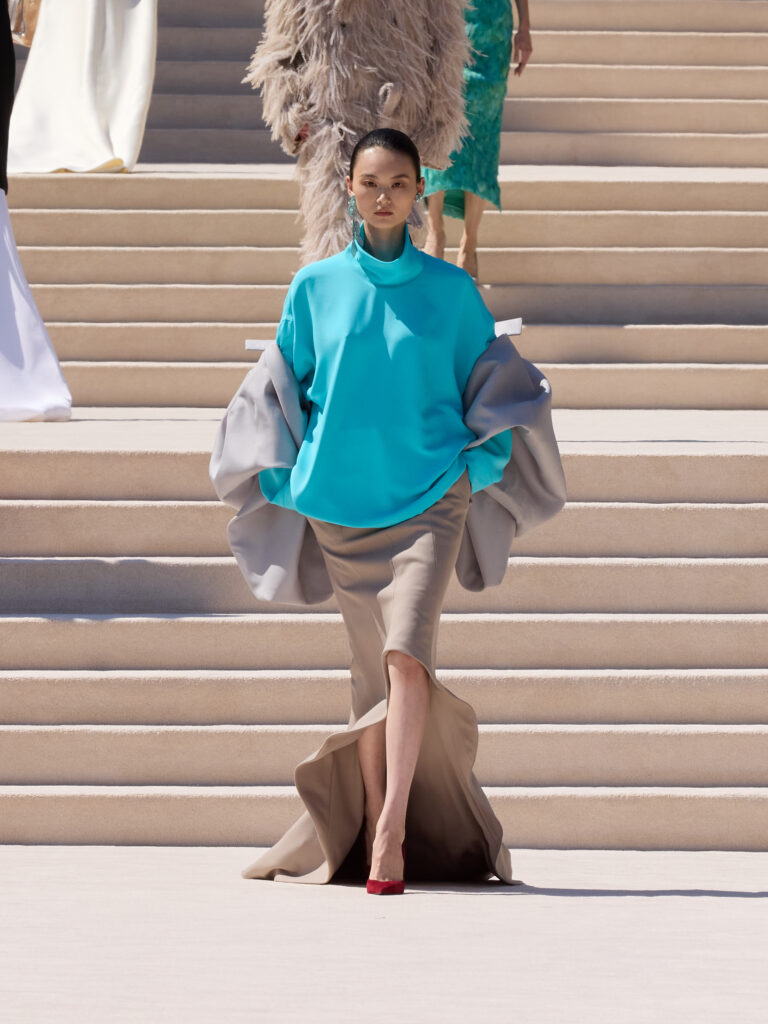
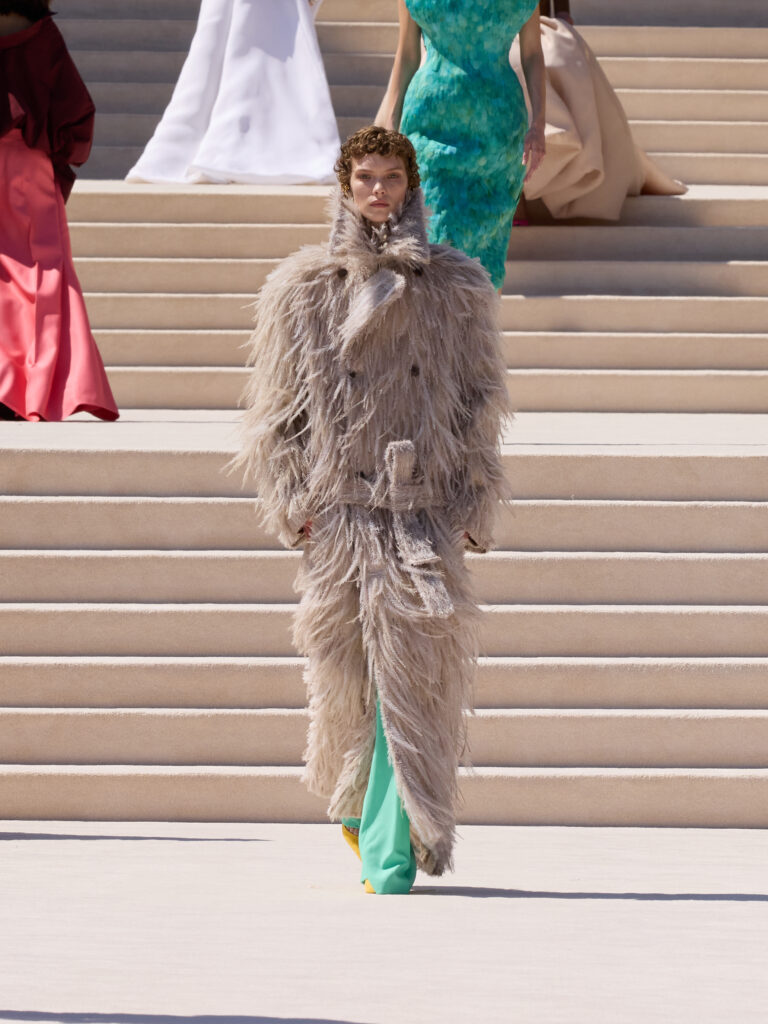
A Material Argument for the Future
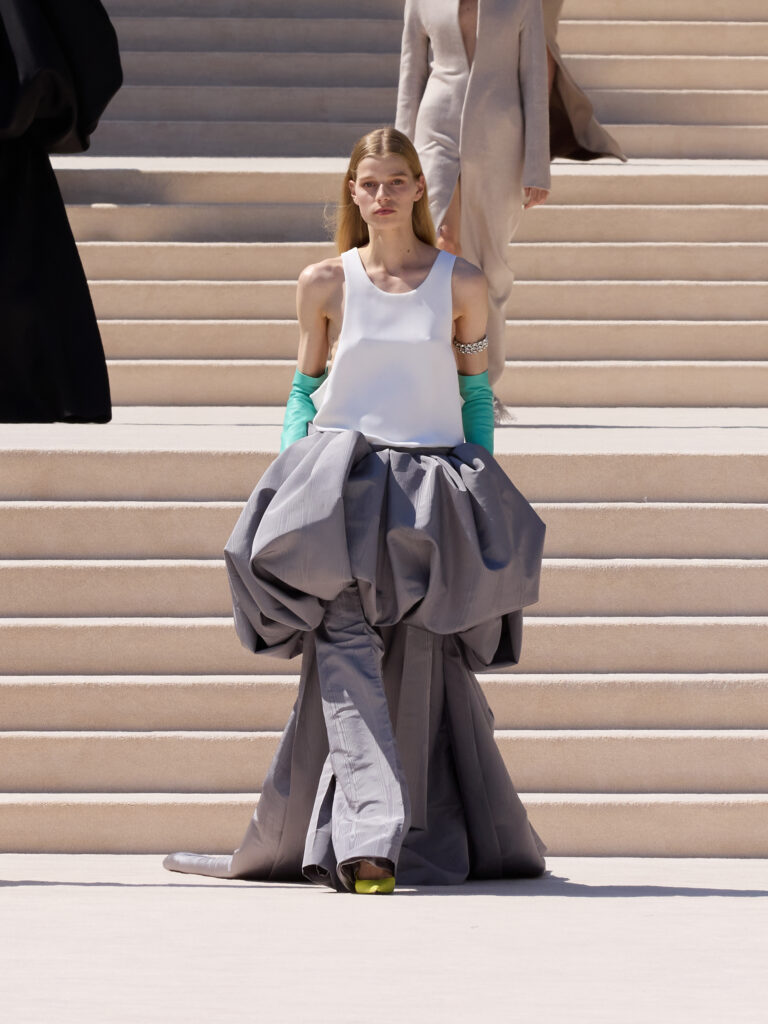
If there is a single detail that separates this collection from an exercise in reverence, it’s AMSilk, a bioengineered silk alternative grown through DNA editing and protein engineering and not harvested from any animal, fossil-fuel-free and, remarkably, some two and a half times the tensile strength of steel. Its introduction into couture, the discipline that has always prized rarity and hand over industrial innovation, is a subtle radical move: Piccioli using the most exclusive corner of fashion as the testing ground for the material future the rest of the industry claims to want. Alongside it, Neo-Gazar, Piccioli’s own reconsideration of the stiff, sculptural gazar Cristóbal Balenciaga invented in 1958, and a fabric he had already reintroduced at his Valentino debut, appears here doing double duty as both the outer shell and the internal architecture of certain garments. It is, in other words, a fabric now capable of holding its own shape from within, which is as close as textile engineering gets to a metaphor for Piccioli’s entire approach at this house: don’t decorate the structure, become it.
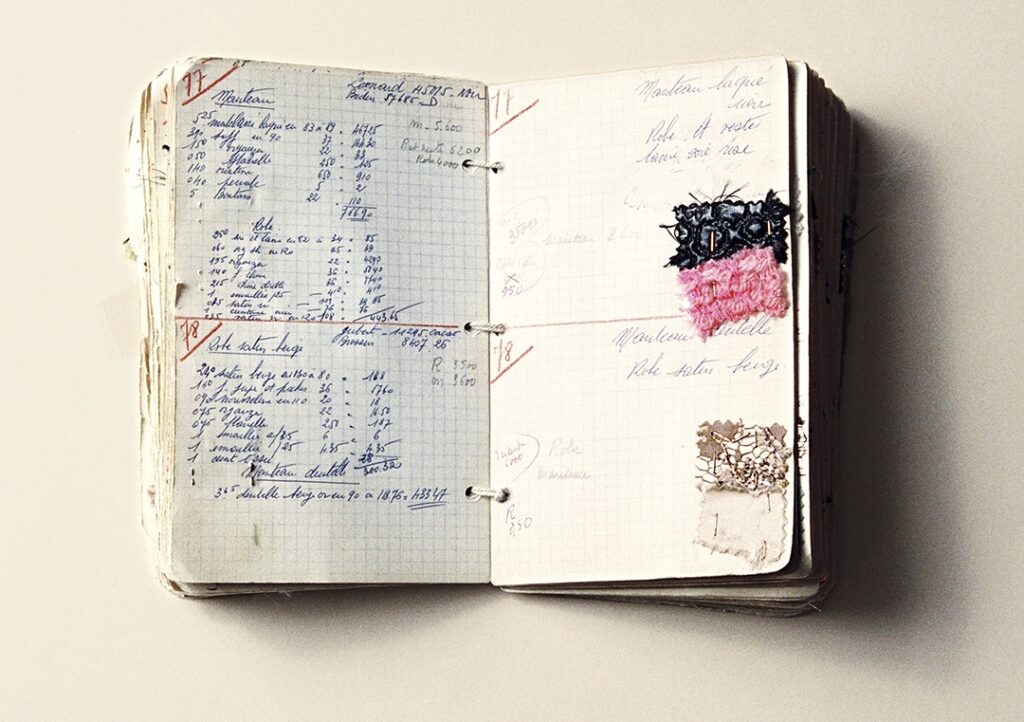
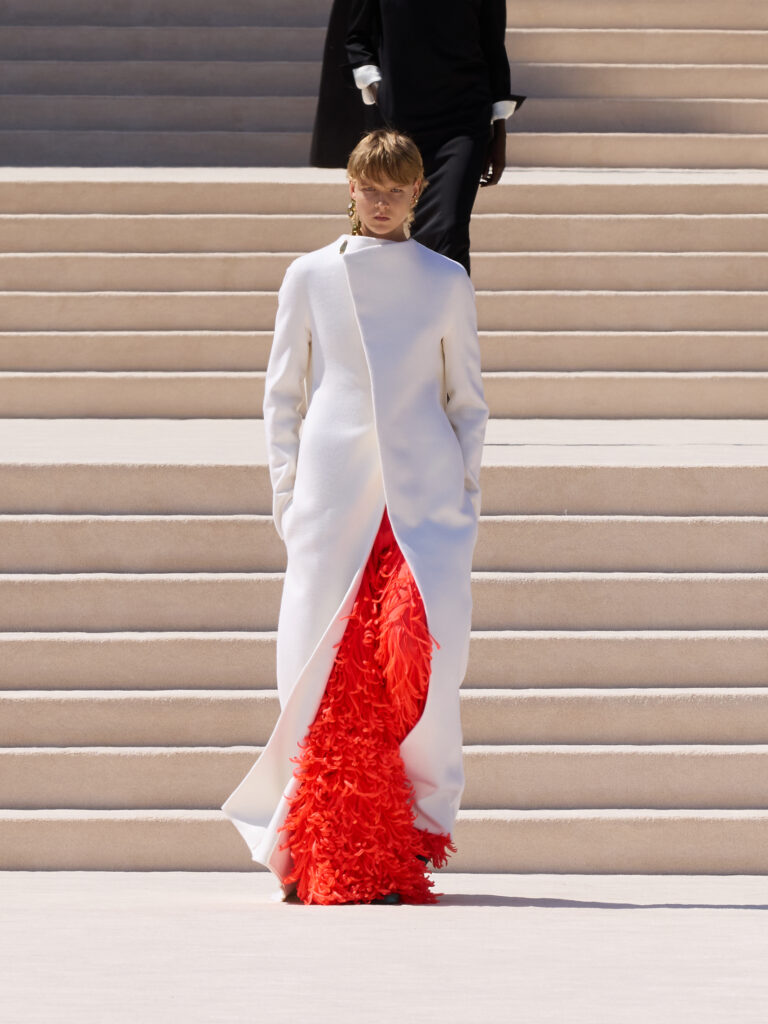
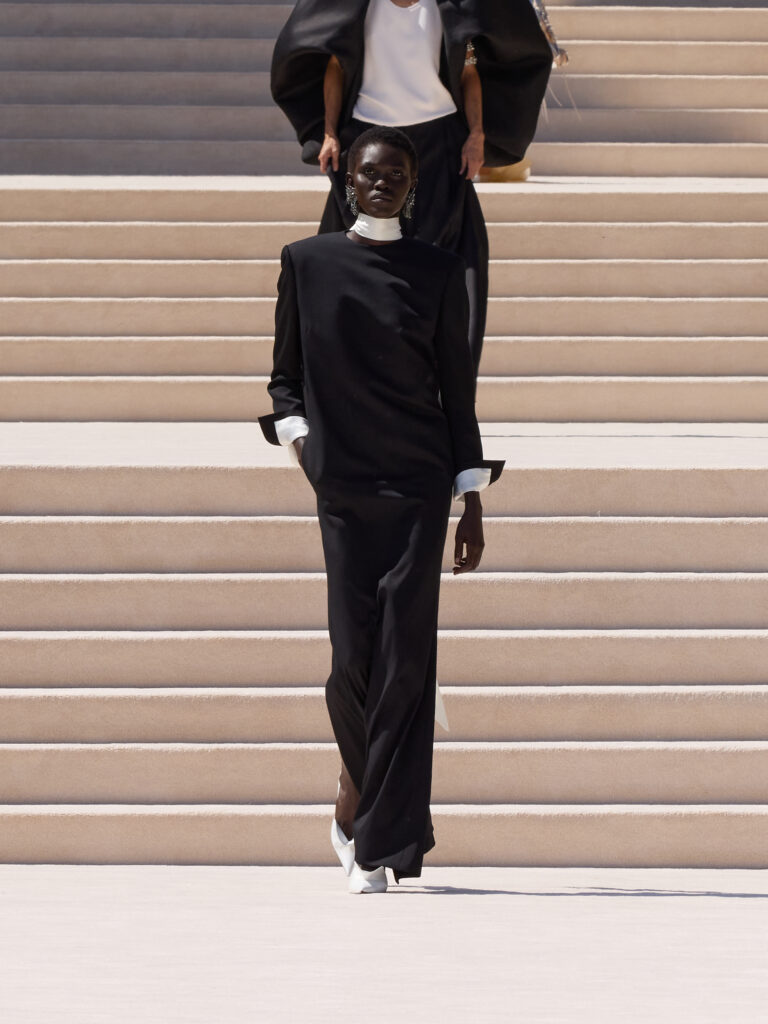
Only someone who has genuinely sat with Cristóbal Balenciaga’s archive would think to repeat a look twice in a single show and then strip the second iteration down to a pure black silhouette, a shadow of itself, purely to reset the audience’s eye. It’s a curatorial trick, not a design one, and it reveals a director more interested in how a room learns to see shape than in how it reacts to spectacle.
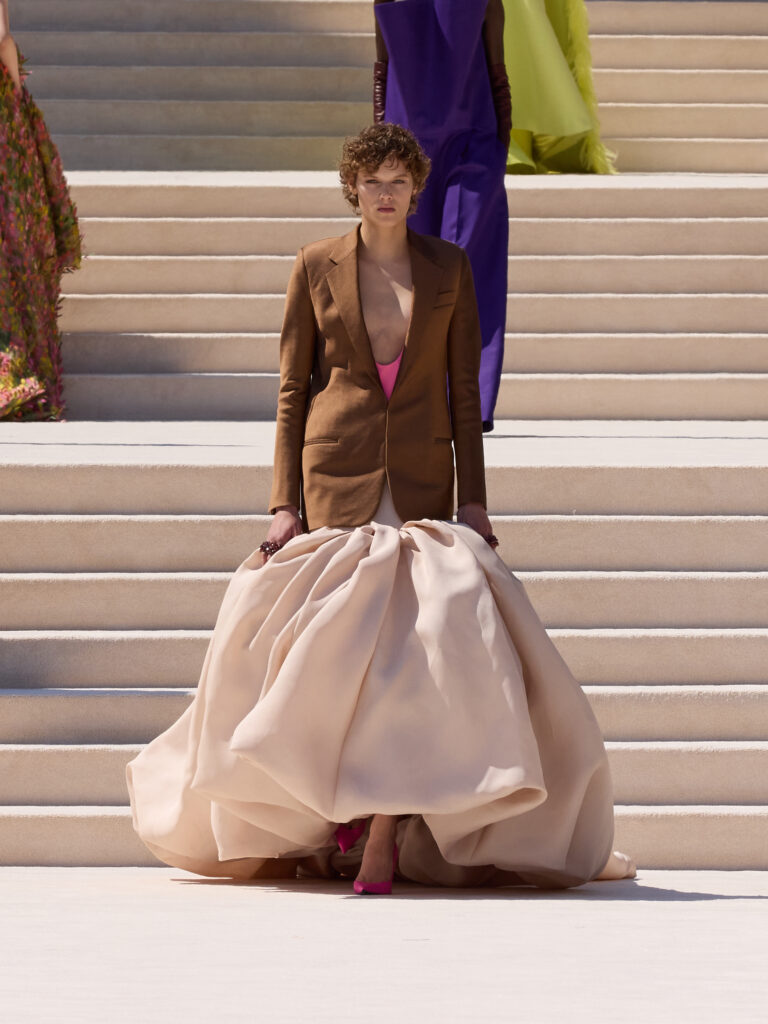
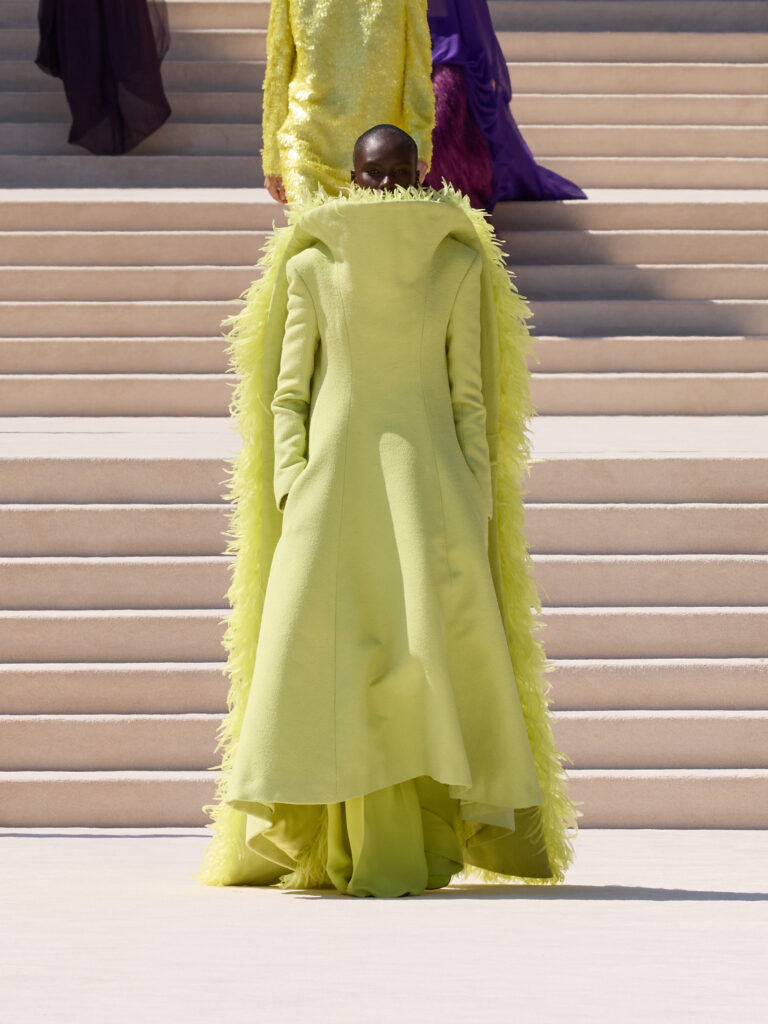
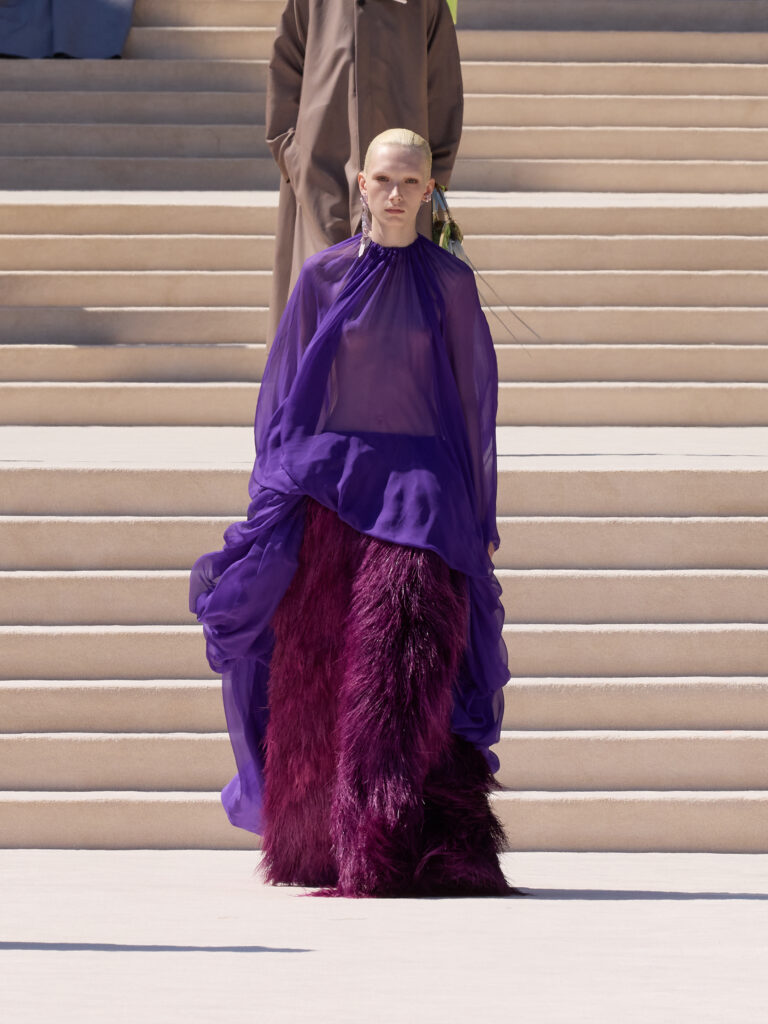
Feathers as Engineering
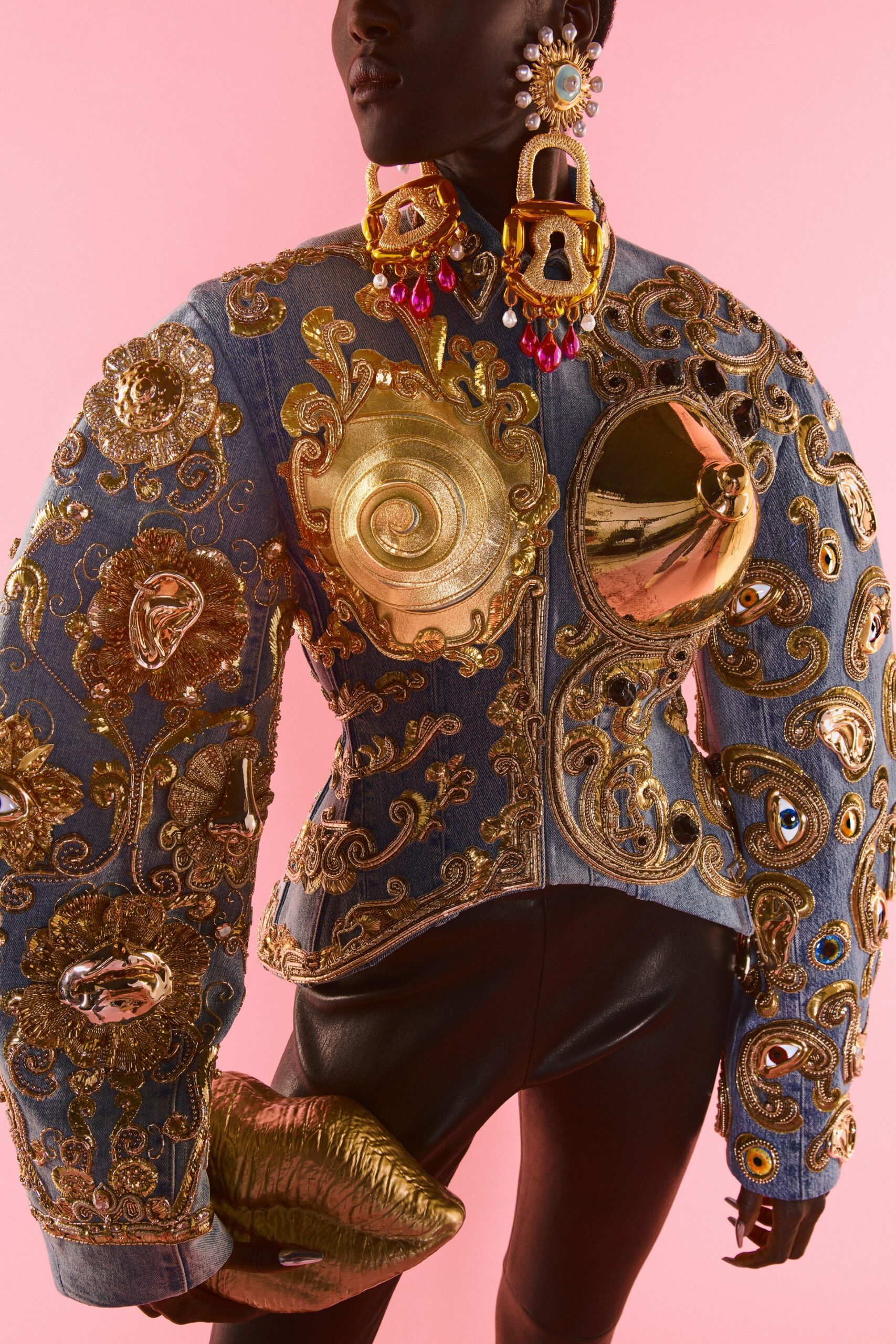
The Philip Treacy collaboration will likely generate the most immediate press coverage and rightly so, sculptural feathered forms blurring the line between millinery and garment are the kind of image that couture week exists to produce. But the deeper insight is textural: feathers here are presented not as ornament but as structural metaphor, weightless and delicate yet possessing real tensile strength, embroideries engineered to bear architectural weight rather than simply catch light. It’s the same paradox running through the AMSilk and the leather carapaces beneath the cashmere, softness doing the work of steel. A viewer who has followed Piccioli since his early years will recognize the signature immediately: he has always been drawn to the idea that fragility and strength are not opposites in a garment but a single condition viewed from two angles.
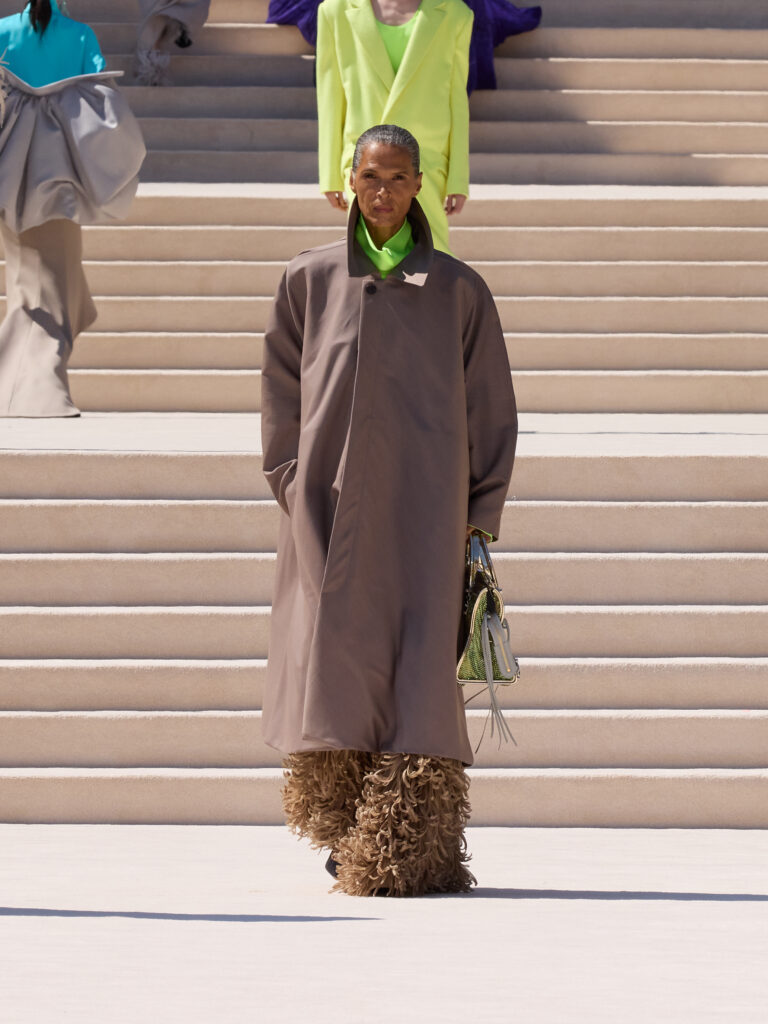
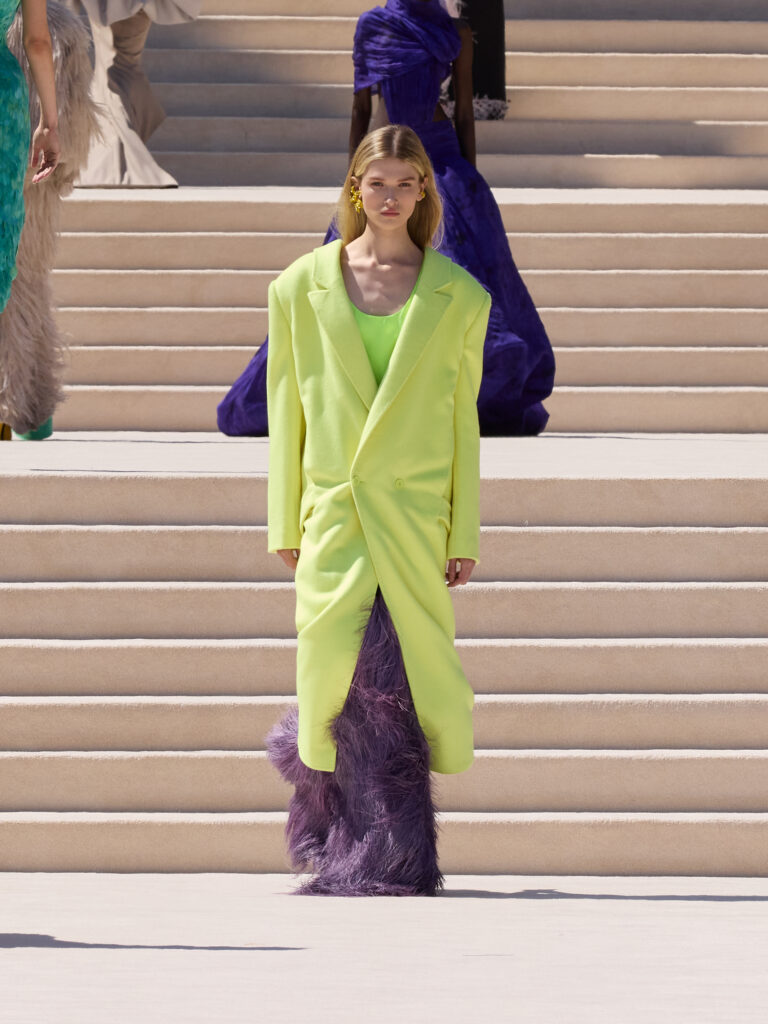
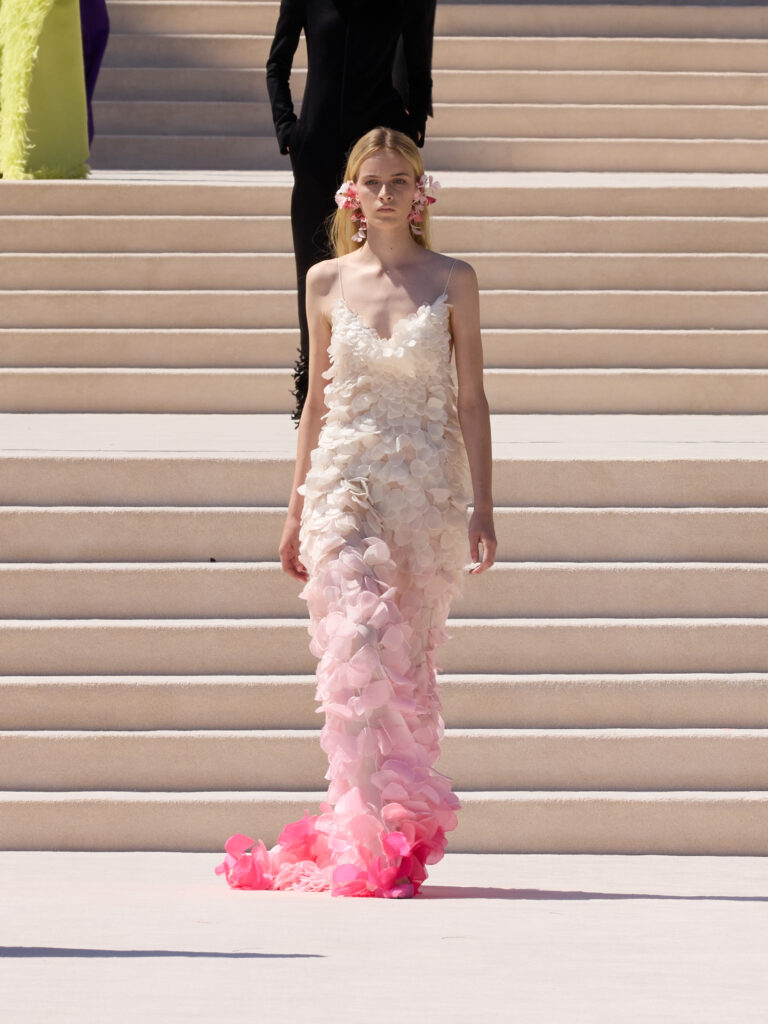
The Piccioli Tell
For anyone who has tracked Piccioli’s design language for two decades, the real giveaway isn’t a silhouette or a colorway; it’s the show notes themselves, and the specific vocabulary he reaches for. “Fundamentalism.” “Belief systems rather than superficiality.” These are not casual words; they are the same register he used at Valentino to describe couture as an almost devotional practice, a discipline of conviction and absolutely not a trend. Transplanted onto Cristóbal Balenciaga, a designer who was, by every account, genuinely monastic in his relationship to the craft, famously uninterested in fame or interviews, the language fits with an ease that feels less like homage and more like recognition. Piccioli isn’t dressing up as Cristóbal Balenciaga. He is pointing out, gently but insistently, that they were always speaking the same language, decades apart.
Couture debuts are usually judged on a single, blunt axis: did the new designer honor the house or did they impose themselves upon it? Piccioli’s 55th Collection refuses the premise of that question. There is no imposition here because there was never really a collision to resolve, only two designers, seventy years apart, arriving independently at the same conviction: that a garment’s meaning lives in its construction, not its decoration, and that couture, done honestly, is closer to sculpture and architecture than to costume. What Piccioli has done, in his first outing at 10 Avenue George V’s most storied discipline, is that fidelity to a house requires listening closely enough to know exactly which sentence to finish.
The applause that morning in the garden lasted considerably longer than the heat should have allowed anyone to stand for. Nobody seemed to mind. Grazie Pier Paolo