There is a kind of homesickness that has nothing to do with home. You feel it on the flight back from Naples, somewhere over the Alps, when the trolley cart rattles past, and the cabin lights dim, and you realize, with something close to grief, that you are no longer there. Positano has a way of doing this to people. It is not a place so much as a spell: pastel houses stacked like a card trick against the cliffside, lemon trees leaning into the salt wind, the Tyrrhenian Sea doing its best impression of liquid glass. You go for a week. Part of you never quite stops returning.
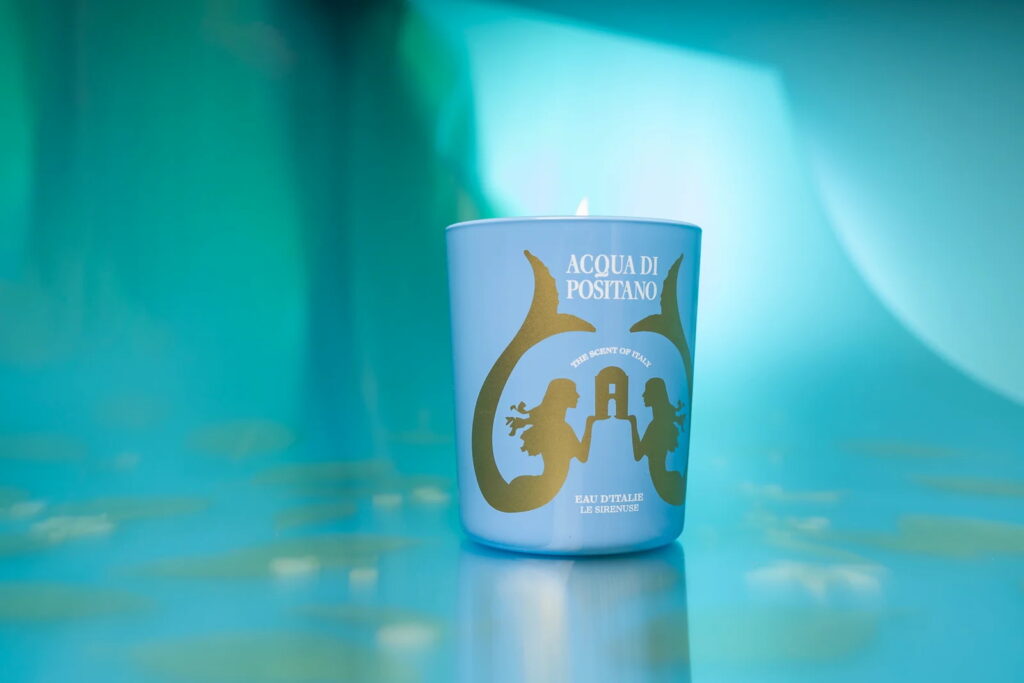
This is the exact, aching phenomenon that Eau d’Italie has bottled—quite literally—with Acqua di Positano, the house’s new fragrance and companion candle, launched twenty years after the brand’s founding meditation on the same coastline. If the original Eau d’Italie was a love letter, this is the postscript: written by people who no longer need to convince themselves the place is magic, only to capture it once again without resorting to cliché. That is, as it turns out, one of perfumery’s most difficult achievements. Simplicity, done well, is the last true luxury.
The scent itself arrives cool and citrus-bright, like the first gust of air-conditioning in a Positano hotel lobby after the climb up from the beach, orange flower unfurling slowly and honeyed underneath, and then, low in the base, something briny and sun-warmed: driftwood, salt, the ghost of a swim you took at golden hour. It smells, improbably, like weather. Like a specific quality of light. It is less a perfume than a place remembered.
We sat down with Marina and Sebastian, the founders who have guided Eau d’Italie since its earliest bottles, to talk about literary briefs, quiet luxury and why some places take twenty years to get right.
Acqua di Positano feels like an atmosphere. When creating this scent, was your ambition to capture the physical beauty of Positano or the emotional memory people carry with them long after they’ve left?
Both. Our “brief” was a sentence written by John Steinbeck in a 1953 Harper’s Bazaar article on Positano and Le Sirenuse: “Positano bites deep. It is a dream place that isn’t quite real when you are there and becomes beckoningly real after you have gone.”
The composition balances luminous citrus, orange flower and salty driftwood with remarkable restraint. How do you preserve that effortless Mediterranean elegance without letting nostalgia become cliché?
It’s been our North Star since we started creating fragrances almost a quarter of a century ago—not to fall into clichés. And I think that is why we “came back” to Positano as a subject twenty years after launching Eau d’Italie: by then we were confident we knew how to approach it successfully. Marie Salamagne, the perfumer, made that miracle happen.
Launching both a fragrance and a candle creates a complete olfactory universe. How do you envision the dialogue between what we wear on our skin and the atmosphere we create in our homes?
In this case, it is an open dialogue between two ways of directly evoking a place—Positano—both on us and around us.
Luxury today is increasingly defined by emotional resonance. Do you believe Acqua di Positano represents a new form of quiet luxury—belonging to place, memory and escapism rather than statement-making?
Our idea of luxury is having the capability and the freedom to choose. We create and offer what we ourselves would want to be offered, and in a time of sensorial excess, we believe deeply in balance and understatement as the truest form of luxury.
Positano has inspired generations of artists, writers and dreamers. If Acqua di Positano were to soundtrack a single cinematic moment on the Amalfi Coast, what scene would you hope people imagine the instant they experience it?
Opening a window onto Positano on a warm, sunny summer day.
What strikes you, listening back, is how quietly confident the house is in its vision. There are no elaborate narratives competing for your attention—just a line from Steinbeck, an open window and twenty years spent waiting until the idea felt right. The result is a fragrance shaped by patience, instinct and the belief that some ideas are worth leaving to mature.
Acqua di Positano is the kind of fragrance you wear for yourself, one that settles close to the skin and becomes part of your own rituals rather than someone else’s impression. It smells of a place, and it never asks to be anything more.
Which might be the quiet point of the whole thing: beauty doesn’t always need to announce itself. Sometimes it’s enough to carry a small, sun-warmed piece of somewhere you love—or somewhere you’re still dreaming of finding.